Writing as Time Travel
9/1/2024
Have you ever dreamt of traveling in time? Everyone says it’s impossible, but I clearly remember the first time that it happened to me. I couldn’t have been more than seven years old, browsing the shelves of my school library when a copy of Laura Ingalls Wilder’s “On the Banks of Plum Creek” caught my eye. I checked it out, began to read, and from the moment the Ingalls family moved into their sod home, I was there with them. I wasn’t reading a book, I WAS THERE with Laura and Mary. I could feel the mud squish between my toes as we splashed in the creek. When we walked the two-and-a-half miles along a dusty wagon track to our first day of school, I scanned the horizon, awed by the vastness of the prairie, and as we battled a blizzard to bring in enough firewood so the family wouldn’t freeze, my fingers were numb with cold.

Wilder’s book transported me to a place I’d never been, her skill in painting pictures with words made me feel what she must have felt as her family struggled to build a home for themselves on the Minnesota prairie. That’s as close as any of us will probably get to time travel. But that’s how powerful the written word can be. It wasn’t long after that I decided that I wanted to be a writer, so that I could create worlds of my own and make them come alive for others.
Finding my calling early in life was fortuitous. I was only fifteen when I began writing my first book in earnest, on a battered, antique typewriter my parents kept tucked away in our basement.
And I’m proud to say that, after only twenty years of study, trial and error, writing and re-writing, and researching through my way through countless shelves of history books, I finally sold that first book. Yes, the same one.
By then, I was a young mother, raising two daughters, the younger of whom is pictured at the beginning of this post. Why, you may ask, is she standing outside of a chicken coop, dressed like . . . well, like Laura Ingalls? While writing my next several books, I volunteered as a docent at Kline Creek Farm, an 1890s living history site near my home, with the hope of gaining a better understanding of what everyday life was like for a 19th century woman.
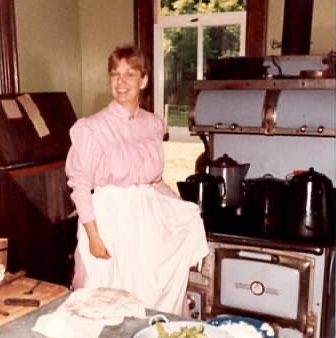
Kline Creek is a real, working farm. At the time I volunteered there, there was corn planted in the fields, sheep and horses in the barn, bees in their hives and chickens in the coop, all of which were tended by a dedicated park district staff and volunteers. For my part, I created period-appropriate clothing for myself and my children, who also volunteered with me on special occasions. (I did not, however, sew any of these on a period-appropriate sewing machine as it would have strained both my patience and my writing deadlines.) That’s me, above, in the farmhouse kitchen.
We volunteers provided tours of the farmhouse, summer kitchen and kitchen garden for visitors, participated in seasonal events, and conducted field-trip programs for local school children, who would alternate between taking the farm tour and helping us in the kitchen to prepare a portion of the noon meal in which they’d all partake. The lessons I learned from living a 19th century life, albeit briefly, are too many to be enumerated here. One thing I can state definitively is that it has cured me of my itch for time travel. While it’s nice to daydream, the reality of spending a hot summer day in a sweltering summer kitchen, feeding wood into a blazing firebox while wearing a long-sleeved housedress and petticoats is far more exhausting than romantic.
And yet, there are unexpected rewards to be had from experiences devoid of the incessant distractions of modern life: preparing delicious meals with only rudimentary kitchen tools, fresh ingredients, and your own two hands or resting on the porch steps on a moonless evening to catch a cool breeze. But when you get up to head home, you realize that you’ve never known a night so dark that you can’t see your hand in front of your face. You stumble about, praying you’ll find the right path through the woods to the parking lot and your own century. My favorite memory, though, is trudging through drifting snow in a world of utter silence, up the lane toward the farmhouse in midwinter, while wrapped in a heavy wool cloak, its deep hood shielding your face from the sharp pellets of snow blowing sideways in the storm. These kinds of visceral experiences are like catnip to a writer.
Circling back again to our time travel theme, I want to make mention of another book that has had a profound effect on my own work. “Bid Time Return” by Richard Matheson is a marvelous science-fiction novel. (Read it if you ever have the chance.) Perhaps you have heard of the movie, “Somewhere in Time”, which is based on this book. It is the tale of Richard Collier, a young writer living in the 1970s who, given the news that he is dying of an inoperable brain tumor, decides to spend what time he has left traveling and recording his experiences. At the historic Coronado Hotel in San Diego, he comes upon a photograph of Elise McKenna, a beautiful actress who performed in the hotel’s theatre in 1896, and promptly falls in love. Certain that they are meant to be together, he convinces himself that it is possible for him to travel back in time to meet her.
Richard researches everything about her life, then sets out to convince himself that he belongs in 1896. Dressed in a suit from the late 1800s, which he’s rented from a costume house, he lies down on his hotel bed, and using self-hypnosis, he eventually manages to transport himself back in time. (Spoiler alert ahead!) He meets Elise, and not-surprisingly, a love story ensues, but after escaping a violent encounter with her manager, who is intent upon keeping them apart, Richard absently shoves a hand into his jacket pocket, and feeling something hard and round, draws out a copper penny dated “1971”. As soon as he realizes what has happened, the spell is broken, and the lovers are once again separated by time. A postscript to the story, written by his brother after his death, posits that because of his tumor, Richard had most likely been delusional in his last months. He expresses the hope, though, that the story might be true and that Richard and Elise might be together . . . somewhere.
“Bid Time Return” may have been written as science-fiction, but it struck me as a cautionary tale for anyone writing historical novels. Over the years, I’ve done my share of library and school presentations and participated in events at writers’ conferences, sharing some of what I’ve learned about writing and historical research. I often make mention of that last fateful moment in Matheson’s book because it makes the point much better than I could. I may be writing fiction, but I still don’t want my readers to find an anachronism (like that 1970s penny), which will destroy their belief in the world I’ve created.
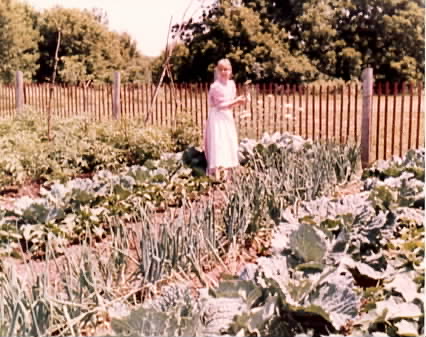

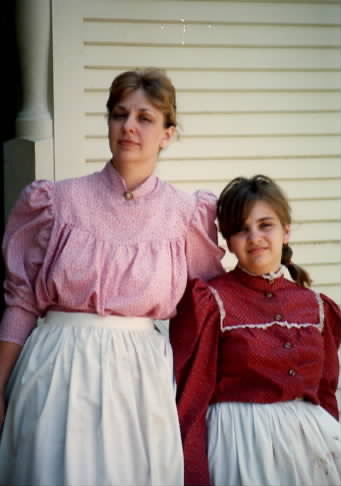


Photos are circa 1990s. Both of my daughters are grown-ups now, with kids of their own.
-Laurel Collins
If history were taught in the form of stories, it would never be forgotten.
Rudyard Kipling
 Laurel Collins